2010年5月31日月曜日

Jamming of DW is part of Ethiopia's campaign against press freedom

Press Freedom | 28.05.2010

Jamming of DW is part of Ethiopia's campaign against press freedom
Coinciding with Ethiopia's parliamentary election last Sunday, DW's Amharic service in the country was deliberately jammed. It is part of the government's strategy to silence independent media.

"These methods are a violation of international law and -- what is even more important -- they are a violation of human rights, particularly the right to freedom of information for people all over the world," Deutsche Welle's director general Erik Betterman said following the news of the intentional disruption of Deutsche Welle broadcasting during the election by the Ethiopian government.

Just as in 2007 and 2008, Deutsche Welle's Amharic radio broadcasts were subjected to jamming, i.e. the deliberate interference of Deutsche Welle's short wave signal.

Two and three years ago it was the invasion of Ethiopian soldiers into Somalia and increasing border tensions with Eritrea that led the government in Addis Abeba to disrupt transmission of Deutsche Welle. Germany's international broadcaster has been transmitting in Ethiopia's official language, Amharic, since 1965.
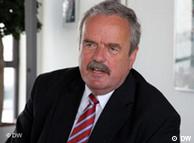
DW Director  General Erik BettermannBildunterschrift: Großansicht des Bildes mit der Bildunterschrift: DW Director General Erik Bettermann protested against the jamming efforts Bettermann has called the renewed interference of DW's frequencies a drastic attack against "Germany's voice for human rights."

Jamming linked to elections

According to Ambroise Pierre, director for Africa at Reporters without Borders in Paris, the government's latest jamming efforts are linked to parliamentary elections in Ethiopia.

"The jamming of Deutsche Welle in Ethiopia must obviously and directly be viewed in a political context. The election on May 23 was an important milestone for Meles Zenawi and his government. This government made it impossible for domestic and international media to inform the Ethiopians independently," Pierre said.

On the world stage Prime Minister Meles, a Marxist and former guerilla fighter who has led the country for 19 years, presents himself as Africa's negotiator on climate issues and the G-20. But at home in Addis Abebba, the seat for the African Union, human rights groups say he bullies the opposition, journalists and civil society activists.

Freedom of press not respected

In May after the jamming of the Amharic broadcasts of Voice of America became public, Reporters without Borders sent an open letter to Meles, urging him to uphold the freedom of the press during the election. That demand was ignored, said Pierre:

"With our letter we wanted to appeal to the prime minister to not interfere with the work of the media. But he obviously didn't heed our demand, since Deutsche Welle is being jammed now as well."

Group  picture with journalists from the Amharic department at Deutsche Welle  in Bonn, Germany.Bildunterschrift: Großansicht des Bildes mit der Bildunterschrift: The Amharic department at Deutsche Welle in Bonn, GermanySince the election of 2005 which was marred by 200 deaths and charges of massive fraud, the Ethiopian government has been engaged in an aggressive lobbying campaign against the Amharic service of Deutsche Welle. These efforts culminated in a complaint to the German parliament alleging that DW's reporting was biased. While this accusation could be invalidated after broadcast manuscripts were re-translated into German, the jamming was only stopped after the intervention of Chancellor Angela Merkel in Addis Abbeba in 2008.

According to Bettermann the continued attacks by the Ethiopian government and the blocking of unpopular Internet sites through the aid of Chinese software and hardware is a confirmation that Germany's broadcaster is on the right track.

"Since this isn't the first time that we are being jammed, this shows that what we transmit to Ethiopia must be considered as very serious," he said and added that the government in Addis Abbeba must be "thin-skinned" to block media access. Information educates the people and governments must be able to withstand criticism, he stressed.

Ethiopian authorities could not officially be reached for comment. However, confronted with the alleged jamming, Prime Minister Meles denied any interference with DW's signal in a conversation with the head of the EU's election observer mission (EU-EOM) in Ethiopia.

Listeners from all over the world have protested against the jamming during the election weekend. In Ethiopia people have begun calling in to the Deutsche Welle to express their frustration and regret that the international broadcaster could not be heard reporting on the country's election.

Author: Ludger Schadomsky (mik)
Editor: Kristin Zeier

2010年5月28日金曜日

Ethiopia jams Deutsche Welle before and during elections

Ethiopia jams Deutsche Welle before and during elections

Text of press release by German international broadcaster Deutsche Welle on 26 May

Deutsche Welle [DW] director-general Erik Bettermann has condemned the jamming of DW’s radio programming in Ethiopia. Before and during the parliamentary elections in Ethiopia on Sunday, May 23, Deutsche Welle’s shortwave broadcasts of its Amharic programme was blocked several times.

“This blatant violation of international law and against the basic rights related to the freedom of information is not acceptable,” said Bettermann. “People must be able to form an opinion based on independent and uncensored information - especially in the run-up to elections. Without international sources of media, the censored, national media remains the only choice.”

Deutsche Welle has informed the German Embassy in Addis Ababa and the head of the EU’s Election Observation Mission.

International broadcasters have been affected by jamming several times in the last few months in Ethiopia. Bettermann sees Deutsche Welle as the “German voice of human rights”. He went on to say that DW, along with other independent international broadcasters “factor greatly into the effort to foster human rights in even more countries around the world and shouldn’t be underestimated”.

DW’s radio service for Ethiopia has been broadcast since 1965 and has been affected by jamming time and time again. Although the administration in Addis Ababa denied using jamming techniques in the past, they have recently officially admitted to blocking international media.

Amharic programming from Deutsche Welle and Voice of America are heard daily by millions of Ethiopians - something the local government disagrees with.

The German government has intervened in the past. In 2007, they contacted Prime Minister Meles Zenawi after the DW’s radio service was blocked for months and the source of the jamming in Ethiopia had been identified.

At the beginning of May, Deutsche Welle, Radio Netherlands Worldwide, BBC, Radio France Internationale and Voice of America made a joint declaration on World Press Freedom Day, specifically addressing the free flow of uncensored information. There is an increasing number of countries that are experiencing jamming with regards to satellite and shortwave transmissions as well as the blocking of websites.

(Source: Deutsche Welle press release in English 26 May 10 via BBC Monitoring)

2010年4月3日土曜日

Broadcasting body calls on Iran to stop jamming

Broadcasting body calls on Iran to stop jamming

Fri Mar 26, 10:44 AM

GENEVA (AFP) - The UN's telecommunications agency called on Iran Friday to stop jamming foreign radio and television broadcasts, following European complaints.


ecommunications Union spokesman Sanjay Acharya said that "interference emanating from the territory of the Islamic Republic of Iran... appear to be of a nature which is forbidden under radio regulations."

The ITU's radio regulation board "urged the administration of Iran to continue its efforts in locating the source of interference and to eliminate it as a matter of the highest priority." he added.

The regulation board issued its call following a complaint lodged by France on behalf of the management of the Eutelsat telecommunications satellite whose emissions to Iran were being jammed.

Acharya acknowledged that the ITU could not impose any sanctions against Tehran before its next world congress in some two years' time.

"What we can do at this moment is to add pressure on the government of Iran," he said.

EU foreign ministers on Monday vowed to "act" against the Iranian state's unacceptable jamming of satellite broadcasts and Internet controls, showing the bloc's increasing impatience with Tehran.

Nearly 70 foreign radio and television stations that transmit via the Eutelsat satellite to Iran were jammed on February 11, the 31st anniversary of the Islamic Revolution, they said.

Iranian authorities have cracked down on the media and arrested scores of journalists since anti-government protests erupted after President Mahmoud Ahmadinejad's disputed re-election last June.

The Islamic regime has been targeting the BBC's Persian-language broadcasts in particular.

EU sources said that Iranians' text messages were also being intercepted by the authorities in Tehran.

The bloc's foreign affairs chief Catherine Ashton said she was "extremely concerned" about Iran's jamming tactics, without saying what precisely Europe would, or could, do to counter Tehran's tactics.

Meles Vows to Authorize Jamming VOA Amharic Broadcasts

Meles Vows to Authorize Jamming VOA Amharic Broadcasts


19/03/2010

The Ethiopian leader denies having authorized the interference VOA Amharic listeners have been experiencing since February 22. But speaking to reporters Thursday, he acknowledged ordering preparations for jamming, and said as soon as the equipment is working properly, he would give the go-ahead.

[insert caption  here]
[Meles Zenawi]
"We have to know before we make the decision to jam, whether we have the capacity to do it," the prime minister says. "But I assure you if they assure me at some future date that they have the capacity to jam it, I will give them the clear guideline to jam it. But so far there has not been that formal decision to jam."

Mr. Meles said what listeners may have been experiencing for the past four weeks is testing of the jamming equipment.

In justifying his decision to order jamming, the prime minister compared VOA's Amharic Service to the infamous Radio Mille Collines, which broadcast hate messages blamed for inciting the 1994 genocide in Rwanda.

"We have been convinced for many years that in many respects, the VOA Amharic Service has copied the worst practices of radio stations such as Radio Mille Collines of Rwanda in its wanton disregard of minimum ethics of journalism and engaging in destabilizing propaganda," Meles said.

Voice of America Director Danforth Austin issued a statement Thursday saying, "any comparison of VOA programming to the genocidal broadcasts of Rwanda's Radio Mille Collines is incorrect and unfortunate."

He added, "The VOA deplores jamming as a form of media censorship wherever it may occur.

"The statement said VOA's Amharic Service is required by law to provide accurate, objective and comprehensive news and information and abide by the highest journalistic standards."

Austin also noted that "while VOA is always ready to address responsible complaints about programming, the Government of Ethiopia has not initiated any official communication in more than two years."

VOA language service broadcasts to Ethiopia have been jammed in the past around election times. The next election for parliament is just over two months away. But in past instances, the government denied being responsible for the jamming.

Monitors say the recent jamming has only been aimed at Amharic broadcasts, and has not affected other Horn of Africa transmissions to Ethiopia in Afan Oromo and Tigrigna. They are heard on the same frequencies before and after the Amharic broadcast.

The Voice of America is a multi-media international broadcasting service funded by the U.S. Government. VOA broadcasts more than 1500 hours of news and other programming every week in 45 languages to an audience of more than 125 million people.

Email this article E-mail Print this article Print

2010年3月5日金曜日

VOA Amharic Broadcasts Jammed in Ethiopia

VOA Amharic Broadcasts Jammed in Ethiopia

International shortwave radio monitors have confirmed that VOA broadcasts in the Amharic language are being jammed. Amharic is the main official language and the language of commerce in Ethiopia.

VOA representatives in Ethiopia have been received complaints from listeners about noise drowning out its Amharic Service broadcasts. People trying to tune in can hear occasional snippets of the VOA broadcast covered by a loud crackle.

The static began February 22 on all five VOA shortwave frequencies aimed at East Africa in the 25 and 31-meter shortwave bands.

The other foreign broadcast heard in Ethiopia, the German government's Deutsche Welle Amharic language program, also reports experiencing some interference, in the past few days.

Monitors say VOA transmissions in two other Ethiopian languages, Afan Oromo and Tigrinya, are being heard normally. They are broadcast on the same frequencies, before and after the hour-long Amharic program.

VOA and Deutsche Welle were jammed around the time of the last parliament election in 2005, and again before the 2008 nationwide local elections. The next crucial parliament vote is scheduled for May 23.

In 2008, the authoritative BBC monitoring service reported it was able to determine that the jamming signals originated from within Ethiopia. This time, however, no such determination has been made.

In a telephone interview, Ethiopian Communications Office spokesman Shimelis Kemal denied any government involvement in the jamming. "This is a baseless allegation. The government doesn't espouse a policy of restricting media outlets from disseminating their messages to Ethiopian audiences," he said.

Ethiopian officials have often described VOA's Amharic Service as the 'voice of the opposition', saying its broadcasts reveal an anti-government bias. Meleskachew Ameha, an Amharic Service reporter in Addis Ababa, was detained for two weeks, last year, in a case involving alleged possession of illegal broadcast equipment. He was released without charge.

Audience research in 2008 suggested about 11 percent of adult Ethiopians regularly tune in to VOA language service broadcasts.

Voice of America Director Danforth Austin issued a statement Wednesday saying, 'VOA deplores jamming and any other form of censorship of the media'.

The Voice of America is a multi-media international broadcasting service funded by the U.S. Government. VOA broadcasts more than 1,500 hours of news and other programming every week in 49 languages to an audience of more than 125 million people.

2010年2月13日土曜日

International broadcasters condemn illegal Iranian jamming of radio and television channels

International broadcasters condemn illegal Iranian jamming of radio and television channels

International broadcasters – BBC, Deutsche Welle, and Voice Of America - today issued a strong message of condemnation following a new wave of deliberate electronic interference by the Iranian authorities which is affecting their broadcasts. BBC World News – the English language channel - was the latest channel to be jammed this week.

The new wave of jamming occurred as Iranians marked the 31st anniversary of the Islamic revolution.

The jamming is affecting services on the Hotbird satellite which covers audiences across Europe and the Middle East. These include BBC Persian television, the Voice Of America television channel in Persian, the Radio Farda service of Radio Free Europe/Radio Liberty, and Deutsche Welle's television and radio services.

In a joint statement: Peter Horrocks, Director of BBC World Service, Erik Bettermann, Director of Deutsche Welle and Dan Austin, Director of Voice Of America said: "We condemn any jamming of these channels. It contravenes international agreements and is interfering with the free and open flow of international transmissions that are protected by international treaties.

"We call upon satellite operators and those who regulate them to take urgent action to put pressure on Iran to stop this activity. The Iranian authorities are using the same satellite services to broadcast freely around the world including broadcasts in English and Arabic; at the same time they are denying their own people programmes coming from the same satellites from the rest of the world.

"We will not stop broadcasting accurate and impartial news and current affairs into Iran. We will try every avenue to give our large audiences in Iran the television news services that they want.

"The jamming violates article 45 of the Constitution of the International Telecommunication Union that prohibits signal interference and we look to the international regulatory community to take a firmer stance on this deliberate act of jamming.

"Formal complaints have been submitted to the International Telecommunication Union, and other channels are being vigorously pursued to stop further jamming."

World Service Publicity

International broadcasters condemn Iran over 'jamming'

International broadcasters condemn Iran over 'jamming'

BBC Persian TV (file)
BBC Persian Television is one of the channels being jammed by Iran

Three major international broadcasters have strongly condemned Iran for its "deliberate electronic interference" in their broadcasts.

The BBC, Deutsche Welle and Voice of America said the jamming began on Thursday as Iran marked the 31st anniversary of the Islamic Revolution.

They said Iran was broadcasting freely around the world while denying its own people programmes coming from outside.

Earlier, the US accused Iran of using a "near-total information blockade".

A state department spokesman said there were strong indications that the telephone network had been taken down, SMS messages blocked, and internet communication "throttled".

"Iran has attempted a near total information blockade," PJ Crowley said.

We will not stop broadcasting accurate and impartial news and current affairs into Iran
Joint statement by the BBC, Deutsche Welle and Voice of America

"It is clear that the Iranian government fears its own people."

White House spokesperson Robert Gibbs meanwhile said that the web giant, Google, and other internet service providers had been "unplugged" in Iran.

Reporters Without Borders says the blocking of Google's Gmail e-mail system takes the drive to control cyber-space to a new stage.

But the organisation claims that most Iranian internet users know how to sidestep censorship and access blocked websites.

Correspondents say a number of governments - notably China and Burma, as well as Iran - make strenuous efforts to block modern internet communications among their opponents.

'Accurate and impartial'

The BBC, Deutsche Welle and Voice of America said the Iranian authorities' jamming was affecting services on the Hotbird satellite, which covers audiences across Europe and the Middle East.

Iranian President Mahmoud Ahmadinejad at Tehran rally on 11 February 2010
President Mahmoud Ahmadinejad told a rally Iran was now a "nuclear state"

These include BBC Persian Television, the Voice of America Television Channel in Persian and Radio Farda; and Deutsche Welle's Television and Radio services. BBC World News - the English-language channel - was also jammed.

"We condemn any jamming of these channels. It contravenes international agreements and is interfering with the free and open flow of international transmissions that are protected by international treaties," the broadcasters said in a joint statement.

"The Iranian authorities are using the same satellite services to broadcast freely around the world including broadcasts in English and Arabic; at the same time they are denying their own people programmes coming from the same satellites from the rest of the world," they added.

Footage said to show a policeman beating a protester

On Thursday, a day-long security clampdown in the Iranian capital Tehran succeeded in preventing large-scale opposition protests as the nation commemorated the Islamic Revolution.

The opposition turnout was dwarfed by huge crowds at the state-run celebrations in the centre of Tehran.

President Mahmoud Ahmadinejad addressed the rally, saying Iran was now a "nuclear state" and had produced its first stock of 20% enriched uranium.

But the White House said the assertion was based more on politics than science.