2012年12月19日水曜日

North Korea Steps Up Jamming


North Korea Steps Up Jamming

Authorities seek to control the narrative on important political events in December.
nkorea-mourn-kji-305.gif
North Korean TV shows Kim Jong Un (C) bowing during a memorial ceremony to mark the first death anniversary of his father Kim Jong Il in Pyongyang, Dec. 17, 2012.
AFP/NORTH KOREAN TV
North Korean authorities have intensified their jamming of foreign radio broadcasts since the beginning of December, blocking signals from South Korea and the United States almost every day during the last month of a year-long period of mourning for the country’s former leader Kim Jong Il, sources in China say.

North Korean jamming is usually sporadic due to electricity outages and the cost of special facilities, but has now been continuous since Dec. 1, said a source in the border city of Dandong, in China's Liaoning province.

“Listening to RFA [Radio Free Asia] and VOA [Voice of America] is almost impossible due to static, which has continued since the first of this month,” the source said, speaking on condition of anonymity.

A source in the Yanbian Korean Autonomous Prefecture of China’s Jilin province confirmed that static had disrupted reception of RFA broadcasts, adding that broadcasts of South Korea’s KBS (Korean Broadcasting System) were also “getting harder to hear.”

North Korean jamming signals have also interfered with Chinese broadcasts, leaving state-run CRI (China Radio International) programs hard to listen to, said another source, who recently moved to China from Sinuiju, in North Korea.

“[CRI] broadcasting used to have better sound quality than anything coming from South Korea, but they are now hard to hear because North Korea’s National Security Department is sending jamming signals,” he said.

Mourning period

Sources tied the unusual period of unbroken jamming to the first anniversary of the death of former North Korean leader Kim Jong Il, and said that the jamming will likely continue until the end of December.

Hundreds of thousands of North Korean soldiers and civilians gathered in Pyongyang on Dec. 17 for a mass memorial to the late dictator presided over by his son and successor Kim Jong Un.

But North Korea’s mood of mourning was briefly broken last week by the launch of a long-range rocket that successfully placed a satellite in orbit.

North Korea’s authoritarian leaders typically fear that foreign broadcasts will undermine official narratives of important events, possibly leading to the current period of intensified jamming.

Speaking from Beijing, one observer of North Korean affairs said that if foreign radio is now difficult to listen to in the border regions, it may be “impossible” for a time to hear in North Korea itself.

North Korean authorities usually find it difficult to block all broadcasts, though, he said.

“More than 10 radio stations broadcast into the country from South Korea, and other broadcasts come from the United States and Japan,” the source said.

“They send signals on many different channels, so it is hard for the North Korean government to jam all radio broadcasting from outside the country.”

Reported by Joon Ho Kim for RFA’s Korean service. Translated by Ju Hyeon Park. Written in English by Richard Finney.

2012年11月26日月曜日

Complaint filed in Paris about jamming of Radio Erena

Complaint filed in Paris about jamming of Radio Erena

Published on Thursday 8 November 2012.
Reporters Without Borders filed a complaint with the public prosecutor in Paris on 6 November accusing persons unknown of acts of piracy against Radio Erena, an Eritrean exile radio station based in Paris which broadcasts by satellite to the Horn of Africa and which is backed by Reporters Without Borders.
A pirate transmission jammed the station’s signal on 14 August. Arabsat, the satellite operator that carried Radio Erena on its BADR-6 satellite, reacted by suspending the station because the jamming was disrupting other signals. It restored Radio Erena on 2 September only to suspend it again two days later, this time indefinitely, because the jamming had resumed. The station’s website was meanwhile the target of a cyber-attack on 28 August. More information about all these acts of piracy.
“Radio Erena’s programmes can no longer be heard by Eritreans living in Eritrea because its satellite broadcasting has been paralysed for more than three months,” Reporters Without Borders said.
“A judicial investigation has to be launched in France with the aim of establishing the precise origin of these acts of sabotage and prosecuting all those responsible, both the perpetrators and the instigators. We have done this because we want to shed light on all the circumstances surrounding this piracy, including where the jamming is coming from and who ordered it.
“Geolocation indicates that the pirate transmission jamming the signal originates from within Eritrea. The government must be doing this in order to gag an independent broadcaster it clearly finds very irritating. This should come as no surprise from the rulers of a country ranked last in the Reporters Without Borders press freedom index for the past five years.
“But President Issaias Afeworki’s government will not get away with it. The complaint that we have filed points out that this piracy is completely illegal. Neither Radio Erena nor Reporters Without Borders have said their final word.”
The Radio Erena staff and its supporters have been able to repair the damage to the website while mirror sites have been created. But satellite broadcasting has not resumed so the station is not being received in Eritrea or anywhere else in the Horn of Africa.
For the time being Radio Erena is only broadcasting on the Internet, but only the Eritrean diaspora can access the web broadcasts because the Internet is not sufficiently developed in Eritrea.
As a Paris-based radio station, Radio Erena operates under a convention ratified by France’s Higher Council for Broadcasting (CSA). The complaint alleged “disruption of over-the-air broadcasting by an authorized service” and “disruption of an automated data processing system” under article L. 39-1 of the Post and Electronic Communications Code and articles 323-2 and 323-5 of the Criminal Code.
Radio Erena in the French and international press:

2012年11月22日木曜日

Jamming TV satellite broadcasts: Who is doing it, and how?

Help
There has been an increase in the number of complaints about the jamming of satellite TV signals around the world.
Broadcasters such as the BBC, Voice of America, France 24, Deutsche Welle and Al-Jazeera have all seen transmissions of their international programmes jammed recently.
The European Broadcasting Union has accused Iran and Syria of being behind the disruption and of attacking media freedom.
But authorities in Tehran and Damascus say that their broadcasts are also being interfered with.
But how does satellite jamming work? And what can be done about it?
Video produced by Thomas Hannen, with Mike Linstead from BBC Monitoring.
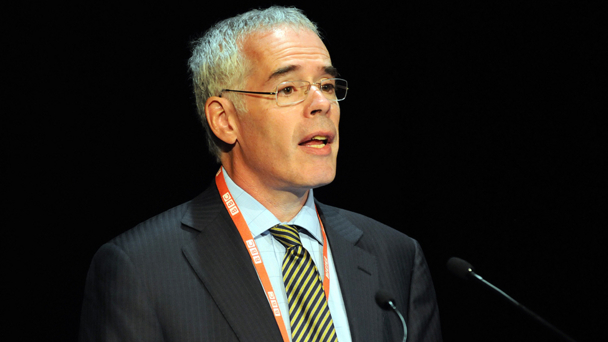
Peter Horrocks
Date: 20.11.2012Last updated: 20.11.2012 at 18.40
Category: World Service
At a conference hosted by the BBC today, broadcasters and satellite operators condemned the sharp increase in jamming of broadcasts, and considered what steps can be taken to address the growing threat of intentional blocking of international broadcasts and internet services.
Article 19 of the universal declaration of human rights states that individuals should have ‘the freedom to seek, receive and impart information and ideas through any media and regardless of frontiers’, but this right is not universally respected.
Satellite owner Eutelsat reports that jamming incidents doubled between 2010 and 2011. The number of incidents has increased three fold from 2011 to 2102. From January 2012 to November 2012, 340 incidents have been recorded. The Middle East-based operator Arabsat has recorded an increase in incidents of deliberate jamming of between 2011 and 2012 of nearly three times. Eutelsat estimates that between 30 per cent and 50 per cent of jamming in 2010 originated in Iran. In 2011, the source was mainly Iran with some interference traced to Syria and Bahrain. This year, most of the interference has been traced to Syria, but jamming also continues in Bahrain and Iran. The current regulatory process offers no direct sanction against countries that allow jamming to originate from within their borders.
Michel de Rosen, Eutelsat CEO says: "Today’s meeting adds more weight to the growing voice of condemnation of pollution of the airwaves and the need for decisive action to combat jamming."
Keynote speaker Jamie Saunders, Director International Cyber Policy at the Foreign and Commonwealth Office, says: “The FCO is a strong supporter of freedom of expression, and we believe that the existing framework of international human rights law is as equally applicable in the digital environment as it is on the off-line world. Specifically, we believe that efforts to block and suppress broadcasting are wrong and are bound to fail over time: we need to understand what more can be done to address deliberate interference, and what part the Government should play.”
Peter Horrocks, Director of Global News at the BBC, says: “Satellite jamming is a growing scourge and a threat to the vital flow of free information. Throughout its history the BBC World Service has countered the efforts of jammers, whether on old shortwave or new satellites. We always called on the guile of the best editorial and technical minds to overcome jamming. Today we do that again to help tackle the menace of jamming."
On the internet, BBC Chinese has been blocked in China since its launch in 1999. BBC Persian has been blocked intermittently from 2006 onwards, and routinely since 2009. The BBC has run pilot services with Psiphon (a Canadian corporation that develops advanced censorship circumvention systems and technologies specifically designed to support users in countries where access to the internet is restricted) to deliver content into China, Iran, Kyrgyzstan and Uzbekistan so that people who want to read BBC news are still able to do so. Over one million pages are viewed weekly through the BBC's Psiphon web proxies. In a study commissioned by BBC in Iran, 97 per cent of respondents believed that unmonitored and uncensored access to the Internet is a universal right.
Chairman of the Foreign Affairs Select Committee, Richard Ottaway MP says: “Gunboat diplomacy is history. Soft power is the future. We live in a globally networked world where human rights abuses cannot hide.”
The International Broadcasting without Barriers Conference brought over 100 delegates from a variety of satellite operators, broadcasters and stakeholders together to consider what political and technical steps that can be taken to make the distribution of media less vulnerable to interference. They face the challenge that jamming is becoming more frequent and there is currently no viable technical solution that can protect direct to home broadcast satellites.
Conference twitter hashtag: #BBCEndJamming

2012年11月14日水曜日

EU demands Iran stop jamming int''l broadcasts

EU demands Iran stop jamming int''l broadcasts
14/11/2012   |   01:57 PM | Gulf News
تصغير الخطتكبير الخط
BRUSSELS, Nov 14 (KUNA) -- The European Union Wednesday accused Iran of jamming broadcast satellites and called on Tehran to stop this "illegal" act.
Since 2009, repeated waves of jamming have affected the signals of European satellites in the Middle East, said Michael Mann, the spokesman of EU High Representative Catherine Ashton, in a statement here today.
"Such jamming, whose origin has been traced to Iran in particular, are hampering the broadcast of international media on Iranian territory. The jamming, notably against BBC, Deutsche Welle, France 24, and Voice of America, has intensified since October 15 and obstructs over 500 TV channels and 200 radio channels," it noted.
"This illegal interference with satellite signals is affecting not only broadcasting on Iranian territory, but also international broadcasting to the wider region. The High Representative is highly concerned by such practices," said the statement.
Ashton recalled the regulations of the International Telecommunication Union (ITU) which forbids states "to carry out unnecessary transmissions, or the transmission of superfluous signals, or the transmission of false or misleading signals, or the transmission of signals without identification." The High Representative calls on Iran to abide by its obligations under the ITU Radio Regulations and to "cooperate in the detection and elimination of harmful interference," added the statement.(end) nk.wsa KUNA 141357 Nov 12NNNN

2012年10月23日火曜日

EBU says Syria suspected of jamming satellite broadcasts

EBU says Syria suspected of jamming satellite broadcasts


GENEVA | Mon Oct 22, 2012 9:24am EDT
(Reuters) - Syria is suspected of jamming broadcasts by the BBC, France 24, Deutsche Welle and the Voice of America, the European Broadcasting Union (EBU) said in a statement on Monday, citing satellite operator Eutelsat.
Eutelsat had already blamed Iran for deliberately jamming satellite signals on October 4, but the EBU said Eutelat had reported "deliberate and intermittent interference" from regional ally Syria as well.
"Access to information is a universal human right and an essential component for democracy. We deplore this attack on media freedom," EBU Director General Ingrid Deltenre said.
The EBU said the jamming may be linked to Eutelsat's decision to stop carrying 19 channels operated by Islamic Republic of Iran Broadcasting, which were taken off air to comply with tougher European Union sanctions.
Deliberate interference with broadcast signals is banned by the International Telecommunication Union, a U.N. body which includes both Iran and Syria among its membership.
(Reporting by Tom Miles; Editing by Alison Williams)

2012年10月19日金曜日

Jamming interrupts Western broadcasters

INTERNATIONAL RELATIONS

Jamming interrupts Western broadcasters

Programming from the Deutsche Welle and other foreign broadcasters has been jammed in parts of the Middle East. DW Director General Erik Betterman called the interruption an attack on freedom of the press.
Western radio and television broadcasts to parts of the Middle East have apparently been cut off because of a targeted jamming attack. In addition to programming by Deutsche Welle, the BBC and Voice of America have also been affected.
European satellite operator Eutelsat said earlier this week that the "deliberate and intermittent interference" originated in Syria.
Deutsche Welle programming was last interrupted on Thursday morning (18.10.2012). DW Director General Erik Bettermann protested against the renewed attack on freedom of expression. In cooperation with other foreign broadcasters, the Deutsche Welle was preparing a resolution against the jamming, Bettermann said.
Experts suspected that Iran was behind the current interruptions. According to media reports, the country has jammed reception of a variety of broadcasters in recent years.
The most recent episode, experts said, could be connected to a Eutelsat decision to stop carrying 19 Iranian channels. The satellite operator on Monday stopped broadcasting television and radio stations operated by Iran's state media organization, Islamic Republic of Iran Broadcasting (IRIB). Effective immediately, the programming offered by these channels, including the international news channel "Press TV," is no longer available outside of Iran.
Eutelsat has stopped broadcasting television and radio stations operated by Iran's state media organization, Islamic Republic of Iran Broadcasting (IRIB). Effective immediately, the programming offered by these channels is no longer available outside of Iran. Among the 19 stations affected by the decision is the international news channel, Press TV.
The European satellite operator justified its actions by referring to a March decision by the Council of the European Union, when EU leaders placed IRIB head Ezzatollah Zarghami on its list of sanctioned persons. Eutelsat, which is based in France, also cited a request by the French broadcasting authority to shut down IRIB channel Sahar 1 TV.
Iran considers legal action
Ezzatollah Zarghami, left, and Mahmoud Ahmadinejad (Foto: FARS) IRIB head Zarghami, left, is on the EU's list of sanctioned persons
Iran has protested the decision, calling it an attempt "to prevent a dissenting voice to the broadcasting of Western thinking." Speaking with DW, the Iranian embassy in Berlin said Eutelsat's actions were illegal and a clear violation of press freedoms and freedom of expression. "The Islamist Republic reserves the right to take legal action against these measures," said a spokesperson.
Anja Zimmer, head of the German Federation of Journalists (DJV) in North Rhine-Westphalia, was also critical of Eutelsat's decision. "Regardless of this case, a broadcaster should not be prevented from airing its programming," she said. "A satellite operator should, on principle, not censor its content."
Censorship and show trials
It's somewhat of a surprise that the Iranian regime chose to use the "freedom of expression" argument to make its case. This is the same country that ranked near the bottom of the latest press freedom index published annually by Reporters Without Borders. Iran was ranked 175th of 179 countries.
"I don't find it terribly convincing that a country that so obviously tramples press freedoms is now so enraged," said Zimmer. "After all, the information broadcast to the public by Iranian state radio is rather more filtered than free, to put it mildly. That this country would now dare to bring up the issue of press freedom is surprising."
IRIB also didn't balk at showing forced confessions and show trails in August 2009 and December 2011, clear violations of international law that resulted in the EU Council's decision to sanction IRIB head Zarghami.
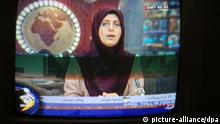
A female newsreader on Iranian TV, with headscarf Foto: Tilman Billing +++(c) dpa - Report+++ Iran has ranked poorly on the press freedom index
The Iranian regime and Eutelsat were involved in another conflict a few weeks ago, when the satellite operator complained that Iran had been disrupting the domestic transmissions from the Persian-language offerings of Western broadcasters - an accusation that Tehran has denied.

DW.DE